
2026 Hive Minds Schedule

Featured Webinars
Recognizing and Mitigating Queen Events - Jamie Ellis (January 14, 2026)
Beekeepers regularly report that queen quality and management are responsible for a significant portion of their colony losses. In this lecture, Dr. Ellis will convey the most important queen-related stressors and discuss how to address these issues by effective stock selection and requeening.
The Infamous Tropilaelaps Mite - Rogan Tokach (January 21, 2026)
Tropilaelaps mercedesae is a parasitic mite on western honey bees causing increased concern as it continues its global expansion being discovered in new geographic areas. This talk goes into detail about the mite’s biology and life cycle, how it causes harm to honey bee colonies, and mite dispersal. Current monitoring efforts being undertaken to determine rapid detection and government response is also addressed. Lastly, the talk finishes up describing the different management practices that can be utilized to assist in control of this parasitic mite threat.
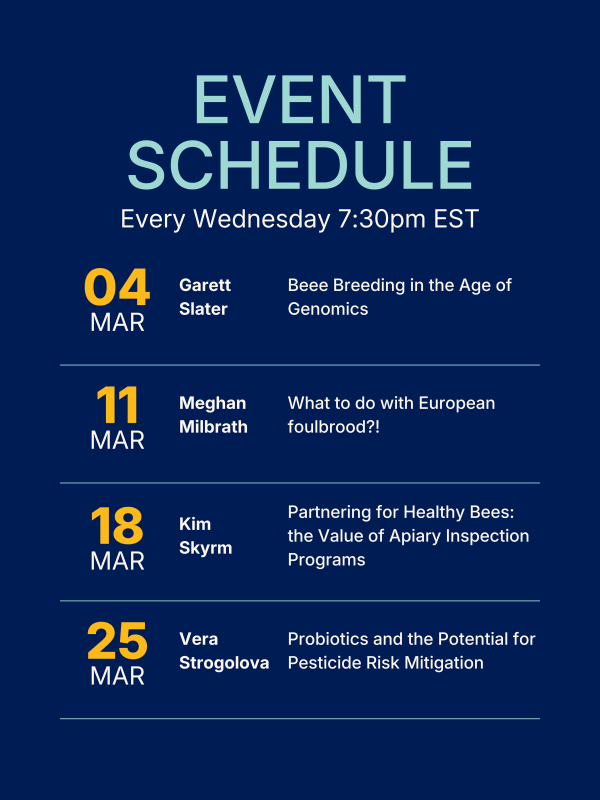
Bee Breeding in the Age of Genomics - Garett Slater (March 4)
Across North America, beekeepers lose up to 45% of their colonies each year. One promising solution lies in selective breeding—and genomics can play a key role. By identifying genetic traits linked to strong, productive, and resilient colonies, beekeepers can raise queens better suited to today’s challenges. Unfortunately, these genomic tools have not been develooped for beekeepers. Garett Slater is working to change that. In this session, he will share updates on his efforts to develop practical, easy-to-use genomic tools that help beekeepers select and breed queens with desirable traits. He will also explain how these tools can help commercial and sideline operations make more informed breeding decisions.
What to do with European foulbrood?! - Meghan Milbrath (March 11)
European foulbrood is a frustrating disease of honey bees that seems to be on the rise. In this talk we will cover some basics of EFB, and will teach you what to do if you suspect EFB in your hives. We will cover diagnosis, confirmation, treatment options, and prevention of this bacterial brood disease.
Partnering for Healthy Bees: the Value of Apiary Inspection Programs - Kim Skyrm (March 18)
Apiary inspection programs play a vital role in supporting honey bee health, preventing the spread of pests and diseases, and strengthening the sustainability of beekeeping. This presentation will explore how these programs operate, the science and services behind them, and the many ways they benefit both individual beekeepers and the broader industry. By highlighting real-world examples and practical strategies for collaboration, attendees will gain a clearer understanding of how partnering with inspectors can build trust, improve colony management, and promote a healthier, more resilient beekeeping community.
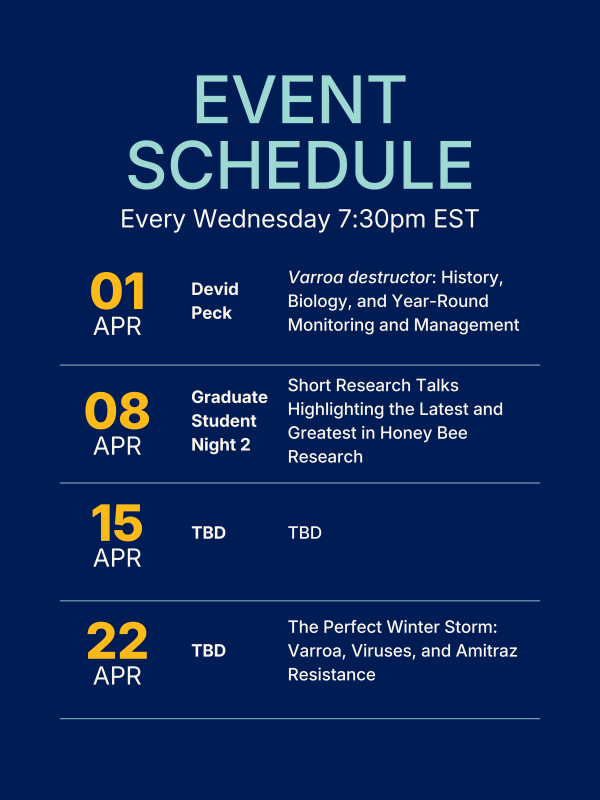
Varroa destructor: History, Biology, and Year-Round Monitoring and Management - David Peck (April 1)
In this lecture, we’ll explore the most important aspects of varroa mite biology, getting to know this devastating parasite of honey bees. Then, once we understand our enemy, we’ll learn what tools and techniques we have to manage and kill them in our hives. We will emphasize the importance of a Varroa Management Plan with a year-round scope, instead of occasional panicked attempts to knock the mite population down once or twice a year

